


Aluminium Windows for Factories and Industrial Buildings in India
Factory buildings are designed differently from homes or office spaces.
The scale is larger. The working conditions are tougher. And small design mistakes become expensive very quickly.
That’s why aluminium windows for factories and industrial buildings are not just about ventilation or natural light. They directly affect productivity, maintenance costs, safety, and long-term building performance.
And in most modern industrial projects today, aluminium window systems have quietly become the preferred choice.
Not because they look modern.
Because they survive industrial conditions better over time.
Why Industrial Buildings Have Unique Window Requirements
Industrial buildings deal with realities that normal commercial buildings usually don’t.
Large factory floors often require longer window spans and wider openings. Ventilation is critical — heat, dust, fumes, and machine-generated air buildup can become serious operational problems.
In many factories, especially chemical plants or coastal manufacturing units, corrosion becomes another challenge. Traditional steel systems start showing rust surprisingly fast in these environments.
Then there’s maintenance.
Nobody wants to shut down production every few years just to repaint or repair window systems. That’s one reason aluminium works well in industrial projects — it handles tough environments with far less upkeep compared to traditional materials.
There’s also a regulatory dimension worth knowing.
In June 2024, the Bureau of Indian Standards published IS 1948:2024 — the first revision to India’s aluminium fenestration standard since 1961. A mandatory Quality Control Order (QCO) now requires every aluminium door, window, and slider sold in India to carry the ISI Mark. Manufacturers who cannot demonstrate compliance face penalties under the BIS Act, 2016. For industrial project managers and developers, this means specifying from a certified manufacturer is no longer optional — it’s a compliance requirement.
Types of Aluminium Windows Used in Factories and Industrial Buildings
Different industrial spaces require different window systems.
Fixed aluminium windows
These are commonly used where natural light is needed without ventilation. Warehouses and production zones often use fixed glazing for visibility and daylight across large floor areas.
Aluminium louvre windows
Louvre systems help control airflow while still protecting interiors from direct rain exposure. They are widely used in factories that require continuous ventilation — textile mills, food processing units, and general manufacturing facilities.
Top-hung and projected aluminium windows
These systems are practical for smoke ventilation and heat exhaust. Many industrial buildings install them at higher levels where hot air naturally rises, supporting passive ventilation and NBC smoke ventilation compliance.
Aluminium sliding windows for office areas within factory buildings
Administrative cabins, control rooms, and meeting rooms inside factories often use sliding systems — simple, compact, and easy to maintain. ALCOI’s AluBUILD sliding system supports openings up to 5 sqm per shutter, which works well for larger factory office windows.
High-level clerestory windows
Installed near roof level to improve daylight penetration and passive ventilation across large production floors. Well-placed clerestory windows can meaningfully reduce artificial lighting load during daylight hours.
Fire-rated aluminium window systems
Certain industrial facilities require fire-rated systems to slow fire spread between compartments. FD30 and FD60-rated systems are specified at zone boundaries in manufacturing units, warehouses, and processing plants under NBC fire safety provisions.
Performance Standards for Industrial Aluminium Windows in India
Industrial buildings face much higher structural demands than residential projects.
Wind load compliance — IS 875 Part III.
Large factory sheds and pre-engineered buildings (PEB) must consider wind load performance as per IS 875 Part III. Wide openings experience significant wind pressure — particularly in open industrial zones, coastal locations, and cyclone-belt states.
To put this in real numbers: ALCOI systems are independently tested under ASTM E330 and confirmed with no breakages or permanent deformation at 1300 Pa (165.72 km/h). Proof load testing at 1950 Pa (200.25 km/h) was also confirmed. Certificates are issued by Eminent International Testing Centre.
You can see the full test data on ALCOI’s testing and certification page.
IS 1948:2024 — What it means for procurement
IS 1948:2024 sets enforceable limits across dimensional accuracy, structural strength, wind resistance, water penetration, operational performance, and surface finish quality. It covers aluminium alloys, anodising, powder coating, and hardware — essentially everything that fails on a poorly specified system during the first monsoon after handover.
For procurement teams: requesting IS 1948:2024-aligned systems and ISI Mark documentation from suppliers is now a mandatory compliance step.
Structural performance
Industrial windows often span larger widths and heights than residential or commercial applications. Poorly designed systems flex or deform over time — a real risk in wide-span factory openings.
All ALCOI profiles are extruded from aluminium alloy 6060/6063 T5/T6, optimally designed for structural consistency across large industrial spans. IS 875 Part III structural calculations are included as standard with every commercial proposal — one of the few things that sets system manufacturers apart from local fabricators.
Fire resistance ratings
Industrial buildings may require FD30 or FD60-rated systems at specific zone boundaries, depending on occupancy and fire compartmentation design under NBC.
Anti-corrosion requirements
Coastal factories, pharmaceutical plants, and chemical units need corrosion-resistant finishes and hardware.
ALCOI systems use anti-corrosive hardware as standard. Air infiltration is tested at 600 Pa (Class 4A, EN 12207) and water tightness confirmed at 600 Pa with no seepage (Class 9A, EN 1027) — relevant performance data for coastal and high-humidity industrial environments.
Acoustic performance for office enclosures
Factory offices and control rooms often require better sound insulation to reduce operational noise from machinery. Double-glazed units (DGU) with EPDM gasket sealing provide meaningfully better acoustic performance than single glazing for these internal enclosures.
Design Considerations for Factory and Warehouse Windows
Industrial window design is usually more technical than decorative.
The window-to-wall ratio needs careful balance. Too much glazing increases heat gain — a significant problem in west-facing production floors during Indian summers. Too little reduces natural light and ventilation. The impact of the window-to-wall ratio on building energy use is a useful reference when planning industrial fenestration.
Orientation matters more than people realise. West-facing glazing in factories can increase indoor heat substantially during afternoon hours. In Indian climate conditions, getting orientation right is one of the more impactful decisions in industrial window planning — see choosing the right aluminium window system for Indian climate conditions for a detailed breakdown.
In pre-engineered buildings, aluminium window systems must integrate properly with industrial cladding panels and structural frameworks. Aluminium’s low weight is a practical advantage here — it places less load on PEB cladding rails than heavier materials.
Finish durability matters equally. Powder-coated finishes perform well in most conditions. Anodised finishes provide better chemical resistance for pharmaceutical, food processing, and coastal applications.
Security is another factor many factory owners prioritise. Anti-intrusion hardware and grille integration are common in industrial projects, particularly at perimeter and ground-floor windows.
Aluminium Windows for Specific Industrial Applications
Every industry has different operational requirements.
| Industry | Key Requirement | Recommended System |
| Manufacturing plants | Ventilation, dust control, daylight | Louvre + fixed combination |
| Warehouses & logistics | Visibility, office windows | Fixed + sliding for office areas |
| Pharmaceutical & food processing | Smooth surfaces, cleanability | Sealed systems, smooth powder coat |
| Chemical plants & refineries | High corrosion resistance | Anodised finish, marine-grade hardware |
| Data centres | Sealed thermal control | Fixed DGU, no openable sections |
| Textile mills & garment factories | Daylight for production floors | High-level clerestory + fixed glazing |
Manufacturing plants
These facilities prioritise ventilation, daylight, and dust management. Louvre windows at mid-level and fixed clerestory glazing near the roof are a common and effective combination for large production floors.
Warehouses and logistics centres
Loading zones often include office windows and visibility panels for operational monitoring. Sliding aluminium windows for internal office cabins and fixed glazing for perimeter daylight are the standard configuration.
Pharmaceutical and food processing units
Smooth aluminium surfaces are easier to maintain and support hygienic environments. Fully sealed systems with no open joints are the specification standard in GMP-compliant facilities.
Chemical plants and refineries
These projects require higher corrosion resistance because environmental exposure is far more aggressive than standard industrial conditions. Anodised finishes and stainless hardware are the right specification.
Data centres
Data centres prefer sealed aluminium systems with controlled thermal performance. Fixed DGU systems with no openable sections are standard — thermal control matters more than ventilation here.
Textile mills and garment factories
Natural daylight is important for worker comfort and colour accuracy on production floors. High-level clerestory windows combined with fixed side glazing provide balanced light distribution without direct glare.
Aluminium vs Other Window Materials for Industrial Buildings
Steel windows are strong but require regular maintenance in humid or corrosive environments. Repainting and rust treatment are recurring costs that add up across large industrial facilities.
uPVC performs adequately in some residential applications but is generally not suitable for large industrial spans and heavy-duty structural requirements. Frame deflection under load is a known limitation.
Aluminium sits in a practical middle ground. It remains lightweight while still handling large openings effectively. It resists rust without ongoing treatment. And it typically delivers a longer service life with lower maintenance requirements across the building’s lifespan.
For more context on why aluminium outperforms alternatives in demanding conditions, this breakdown of aluminium vs alternatives is a useful starting point, though it focuses on residential — the structural and corrosion arguments apply equally to industrial use.
Over large industrial projects, lifecycle cost matters more than initial purchase price. That’s where aluminium systems usually prove their value — the case for energy-efficient aluminium windows covers the operational cost angle in more detail.
Cost of Aluminium Windows for Industrial Projects in India
Industrial aluminium window pricing depends on several factors:
- Profile size and span — larger openings with wider unsupported spans require heavier profiles and structural engineering
- Glass specification — single clear glass vs DGU vs fire-rated glass affects cost significantly
- Hardware quality — louvre systems, smoke ventilation actuators, security grilles, and anti-corrosive hardware add to the cost.
- Finish type — standard powder coat is most economical; anodised and specialist finishes carry a premium.
- Project scale — large industrial orders are priced differently from residential; volume affects per-unit cost
- IS 1948:2024 compliance — certified, ISI-marked systems from verified manufacturers are the legally required specification.
Most developers today look beyond upfront cost alone. Long-term durability, lower maintenance, and operational reliability matter far more over a building’s lifespan. An aluminium system that avoids one maintenance shutdown in a production facility typically pays back the cost difference many times over. The full picture on aluminium window pricing in India is a useful reference for budgeting.
ALCOI India: Aluminium Window Systems for Industrial and Commercial Projects
ALCOI India supplies aluminium window systems for industrial, commercial, and institutional projects across India.
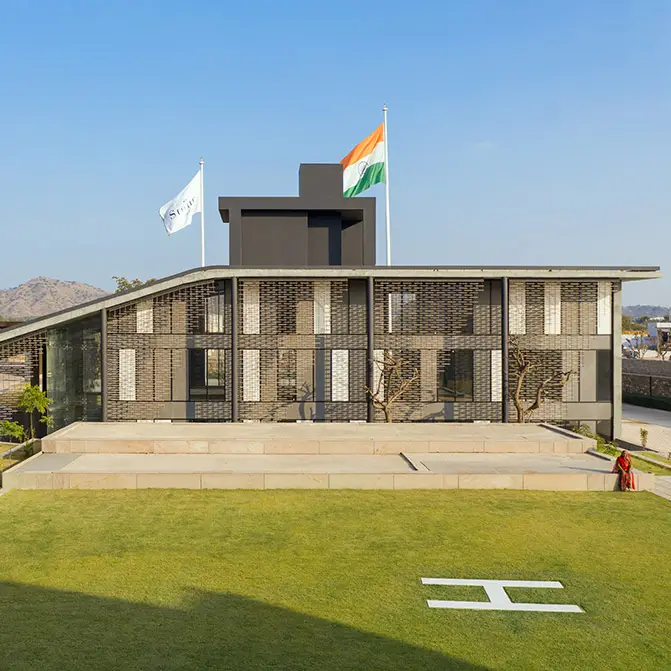
The company has worked on large-scale industrial applications, including the Stonex Factory project in Rajasthan — a direct reference for factory-scale fenestration supply and installation.
What ALCOI brings to industrial projects specifically:
- IS 1948:2024-aligned systems — engineered to meet the mandatory Indian fenestration standard, including ISI Mark compliance
- Independently tested and certified performance — ASTM and EN standards, certified by Eminent International Testing Centre:
- Structural: no breakage at 1300 Pa; proof load confirmed at 1950 Pa (ASTM E330)
- Water tightness: Class 9A, no seepage at 600 Pa (EN 1027)
- Air infiltration: Class 4A, passed at 600 Pa (EN 12207)
- IS 875 Part III structural calculations included with every commercial proposal — not an add-on
- Anti-corrosive hardware is standard across the product range
- Full product range from standard to premium — AluBUILD for standard sliding and fixed, AluFIT for fixed and casement, AluLITE for premium sliding systems
- 500+ completed projects across India, 25-city service presence
- Water hose testing, packaging, and post-installation cleaning are included as standard
Because in industrial construction, performance problems don’t stay small for long. And windows are one of those decisions that quietly affect the building every single day.
For more on what separates a tested system manufacturer from a local fabricator, ALCOI’s advantage page covers this in detail.
FAQs
What type of aluminium windows are best suited for factory and warehouse buildings?
Louvre, fixed, and top-hung aluminium windows are the most widely used in factories and warehouses. Louvre windows provide continuous controlled ventilation; fixed windows maximise daylight without maintenance complexity; top-hung systems handle smoke and heat exhaust at high levels. The right combination depends on the facility’s ventilation load, orientation, and occupancy type.
Do aluminium windows meet fire safety requirements for industrial buildings in India?
Yes. Fire-rated aluminium window systems can be designed to meet FD30 and FD60 fire resistance requirements for industrial buildings under NBC provisions. These are typically specified at compartment zone boundaries, stairwells, and emergency exit corridors.
How do aluminium windows perform in corrosive industrial environments?
Aluminium resists rust significantly better than steel. Powder-coated and anodised finishes further improve long-term durability. For chemical plants, coastal factories, and pharmaceutical facilities, anodised finishes with anti-corrosive hardware are the correct specification. ALCOI systems are independently tested to watertightness Class 9A and airtightness Class 4A — confirming sealed performance in demanding environments.
What wind load standard applies to windows in large industrial structures in India?
Wind load design for industrial buildings in India follows IS 875 Part III. ALCOI systems are independently tested under ASTM E330 at 1300 Pa (165.72 km/h) with no breakage or deformation, and confirmed at proof load of 1950 Pa (200.25 km/h) — giving verified structural data for industrial wind load specification. See the full test and certification details here.
Can aluminium windows be integrated with pre-engineered building (PEB) structures?
Yes. Aluminium window systems integrate well with PEB structures — they are lightweight, suitable for large openings, and easy to interface with industrial cladding systems. ALCOI provides IS 875 Part III structural calculations and shop drawings for PEB integration as part of standard commercial project proposals.
What does IS 1948:2024 mean for industrial aluminium window procurement?
IS 1948:2024 is the first revision to India’s aluminium fenestration standard since 1961, effective from June 2024. A mandatory Quality Control Order requires every aluminium door, window, and slider sold in India to carry the ISI Mark. Non-compliant systems carry penalties under the BIS Act, 2016. For procurement teams, this means requesting IS 1948:2024-aligned systems and ISI Mark documentation is now a compliance requirement. ALCOI’s systems are engineered to meet these standards.
Does ALCOI India supply aluminium windows for factory and industrial projects across India?
Yes. ALCOI supplies aluminium window systems for factories, warehouses, manufacturing plants, and industrial projects across India. With a service presence in 25+ cities through factories, Experience Studios, and Channel Partners, ALCOI supports industrial projects from specification through post-installation maintenance. Contact ALCOI at alcoi.in or +91 987 875 0055 for project-specific enquiries.