

Aluminium Doors for Offices and Commercial Spaces
Walk into any office after a few months of operations- not day one, but after things have settled.
That’s when you start noticing the real performance of materials.
Doors that don’t close properly. Handles that feel loose. Sliding systems that don’t glide the same way anymore.
Nobody talks about it during design. But in commercial spaces, this is where things either hold up… or start failing.
And that’s exactly why aluminium doors for offices have become the default choice in most modern commercial buildings across India.
Why Aluminium Is the Preferred Material for Commercial Doors
Strength without making doors heavy
In offices, doors are used constantly. If they feel heavy, people notice. If they feel weak, they don’t last.
Aluminium sits in a comfortable middle.
It’s strong enough to hold large glass panels, but light enough to operate smoothly even after repeated use. That balance is hard to achieve with wood or steel in the long run.
Lower maintenance in real conditions
On paper, many materials look fine.
But in real office environments, things are different. Air conditioning, dust, humidity, and constant handling.
Wood starts reacting to moisture. Steel needs protection against corrosion.
Aluminium generally stays stable. It doesn’t demand attention every few months, which is why facility teams prefer it.
Works with modern office design
Most offices today are moving towards open layouts.
More glass, fewer visual barriers, cleaner lines.
Aluminium allows slim framing without compromising strength, so you get that modern look without making the system fragile.
Performs better over time
The real test is not installation day.
It’s six months later. Or a year later.
That’s when alignment issues, noise, or hardware problems show up in poorly built systems.
Well-engineered aluminium door systems tend to maintain alignment better and operate more smoothly over time.
Types of Aluminium Doors for Office and Commercial Applications
Entrance doors
The entry point sets the tone.
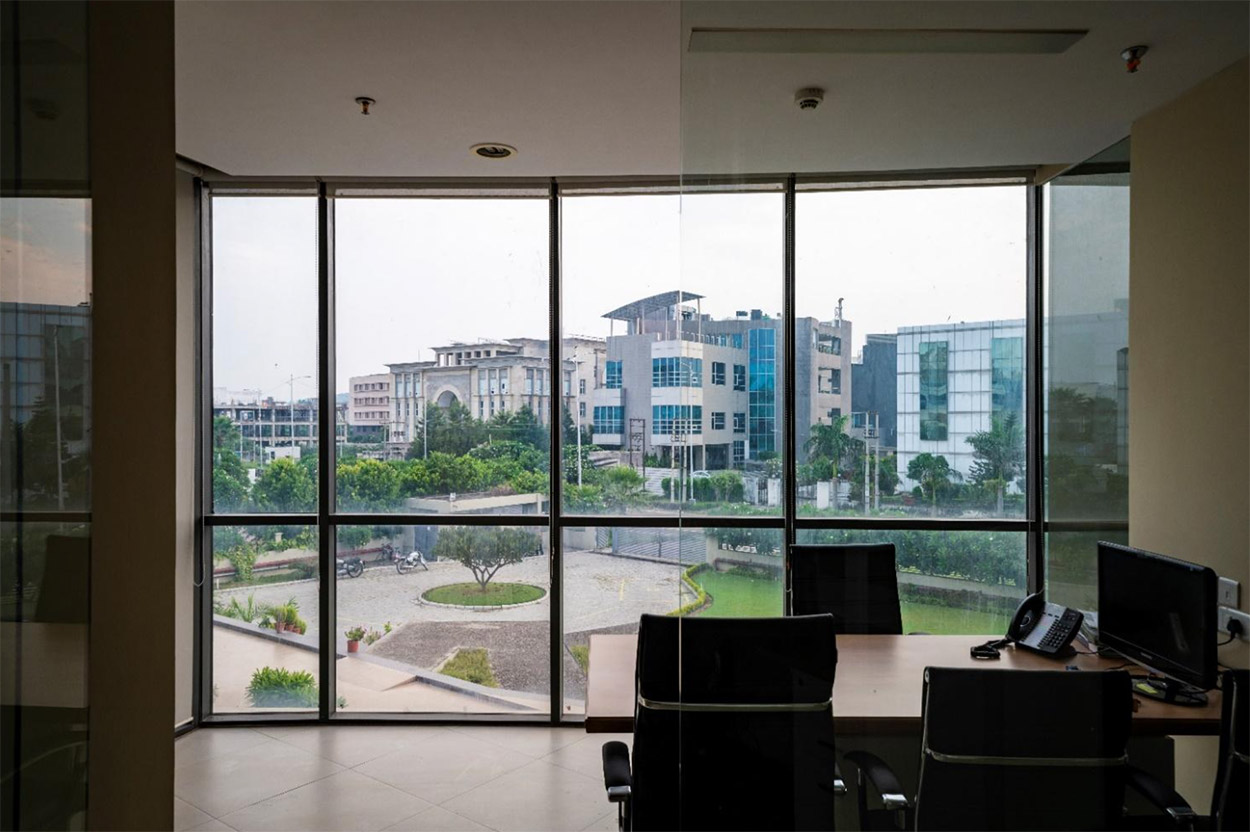
Most offices today prefer glass-heavy entrance doors with aluminium framing because they look clean and professional without feeling overdesigned. Fixed and casement aluminium systems, such as ALCOI’s AluFIT range, are widely used here, offering both fixed-panel and single- or double-leaf casement-door configurations within the same system.
Sliding doors
Used a lot in open-plan offices.
They help divide spaces without blocking light. Also useful where swing space is limited, which is common in compact layouts. Aluminium sliding door systems support large glass panels, up to 5 sqm per shutter, which makes them ideal for internal dividers in corporate spaces.
Swing doors
You’ll still find these everywhere.
Meeting rooms, cabins, internal offices. They’re simple, but only when the hardware is good. Poor hinges are usually the first thing to fail.
Automatic sliding doors
Common in larger offices and commercial buildings.
They reduce physical contact and handle heavy footfall better, especially during peak hours.
Frameless glass doors
These are mostly about aesthetics.
Minimal visible structure, more transparency. But they need precise installation, issues show up quickly.
Fire-rated doors
Often ignored during design discussions, but critical.
These are used in staircases and emergency exits, where performance matters more than appearance.
Design Considerations for Commercial Aluminium Doors
Glass is not just about looks
Clear glass makes spaces feel open, but it also reduces privacy.
Frosted or film-coated glass is often used in meeting rooms. Tinted glass helps with glare in areas facing direct sunlight.
These choices affect daily comfort more than people expect.
Hardware quality makes or breaks the system
This is one of the most common mistakes.
People invest in good profiles and glass but compromise on hardware.
In commercial use, that decision shows up quickly in the form of loose handles, noisy hinges, or doors that don’t align properly. Hardware for commercial aluminium doors should include anti-corrosive materials and multipoint locking mechanisms — standard on well-engineered systems.
Matching brand and interiors
Offices usually have defined colour themes.
Aluminium systems can be powder-coated or anodised to match these requirements, which helps maintain consistency across the space. Available finishes typically include white, warm grey, cold grey, anodic black, anodic bronze, matt black, champagne, and wood-effect sublimation finishes.
Access control integration
Most offices now use controlled entry.
Card access, biometric systems, and electric locks.
Aluminium doors can accommodate these, but planning needs to happen early during design, not after installation.
Door height and proportions
Full-height doors are becoming more common.
They visually open up the space and make ceilings feel higher. It’s a small design move, but it changes perception significantly in open corporate layouts.
Performance Standards for Commercial Aluminium Doors
High usage cycles
In some offices, doors are used hundreds of times daily.
If the system isn’t designed for that, problems show up quickly. Commercial aluminium door systems should be tested for structural performance under repeated load, not just visual inspection at installation.
Acoustic performance
Boardrooms and cabins need some level of sound control.
Without proper sealing, conversations travel more than expected. Look for systems with EPDM gaskets and proper frame-to-sash sealing, which significantly reduce sound transmission between spaces.
Thermal behaviour
In air-conditioned offices, doors shouldn’t allow unnecessary heat exchange.
Otherwise, cooling systems end up working harder. Single glazing and double glazing groove options allow you to upgrade thermal performance based on project requirements.
Security
Commercial spaces need controlled access.
Strong locking systems and stable frames are basic requirements. Multipoint cylinder key locking is the standard for commercial aluminium door systems.
Wind performance
In high-rise buildings, wind pressure can affect door stability.
Systems need to be designed keeping this in mind, especially for external applications. Structural performance calculations as per IS 875 Part III are essential for commercial façade applications.
A Quick Comparison: Aluminium Door Types for Commercial Use
| Door Type | Best For | Key Advantage |
| Framed glass entrance | Lobbies, main entrances | Professional look, structural strength |
| Aluminium sliding door | Open-plan offices, cabin dividers | Space-saving, large glass panels |
| Casement swing door | Meeting rooms, individual cabins | Simple operation, proven hardware |
| Automatic sliding | High-footfall lobbies, retail | Hands-free, high traffic rated |
| Frameless glass | Premium interiors, reception areas | Minimal aesthetics, maximum transparency |
| Fire-rated | Staircases, emergency exits | Safety compliance, compartmentation |
Aluminium Doors Across Different Commercial Spaces
IT offices
Focus is on access control, durability, and clean design.
Retail spaces
Here, doors are part of the display. Transparency and visibility matter more.
Hotels
Balance between appearance and constant usage.
Banks
Security requirements are stricter, but the design still needs to feel professional.
Co-working spaces
Flexibility is key.
Sliding and partition systems are preferred because layouts keep changing.
Why ALCOI India for Commercial Aluminium Door Systems
In commercial projects, most systems look similar at the start. The difference shows later.
Does the door still close properly? Does it make noise? Has alignment shifted?
That’s where system quality becomes visible and it’s where ALCOI’s approach is different.
What sets ALCOI apart for commercial projects:
- Tested and certified systems — ALCOI aluminium door and window systems are tested under both American (ASTM) and European (EN) standards. This includes structural performance tested at 1300 Pa wind load (165.72 km/h) with no breakages or deformation, water tightness at 600 Pa (Class 9A, EN 1027), and air infiltration tested at 600 Pa (Class 4A). Certificates are issued by an independent international testing centre.
- IS 875 Part III structural calculations — ALCOI is one of the first Indian companies to provide structural safety calculations as per IS 875 Part III with every commercial offer. This matters for high-rise and large commercial projects where wind load compliance is mandatory.
- Full commercial product range — From standard-grade AluBUILD sliding systems to premium AluLITE, AluFIT casement and fixed systems, and high-performance SkyLITE lift-and-slide systems — ALCOI covers every commercial door requirement from basic to premium.
- 500+ completed projects — ALCOI has designed, supplied, and installed aluminium door and window systems for over 500 projects across India, working with some of the country’s leading architects. Commercial references include IDS Infotech Chandigarh, Stonex Factory Rajasthan, and The Grand Alabaster Punjab.
- 25-city service presence — With factories, Experience Studios, and Channel Partners across 25+ cities in India, ALCOI supports commercial projects from the design stage through post-installation maintenance.
- 3,000 sq ft Experience Centre — ALCOI’s Experience Centre (XPC) in Panchkula, Haryana, is the region’s largest, where all systems can be seen and tested at life size before specifying for a project.
- End-to-end project support — ALCOI uses CAD and STAAD Pro for structural analysis, and provides clients with detailed calculations, water hose testing, packaging, and post-installation cleaning as standard.
Because in an office, even a small issue becomes noticeable very quickly. ALCOI’s systems are built to avoid that.
Cost of Aluminium Doors for Commercial Projects in India
There’s no fixed number, and any supplier quoting without understanding the project is guessing.
Cost depends on several factors:
- System type — Standard sliding systems are more economical; lift-and-slide and automatic systems carry a higher cost due to hardware and engineering complexity.
- Glass specification — Single glazing vs double-glazed units (DGU) affects both price and thermal performance. Low-E glass and laminated options add to the cost but are often required for energy compliance.
- Frame finish — Standard powder coat finishes are economical; anodised, PVDF, and sublimation wood finishes carry a premium.
- Opening sizes and custom configurations — Larger shutters (above standard maximums) require engineering review and custom hardware.
- Access control integration — Electric locks, magnetic closers, and biometric-compatible hardware add to the system cost.
The better approach is to define requirements clearly and then get a project-specific estimate. ALCOI provides detailed cost estimates based on actual project specifications.
Final Thoughts
In commercial spaces, doors don’t get attention when they work well.
But the moment they don’t, everyone notices.
So the decision is not just about design.
It’s about choosing something that continues to work quietly, every day, without becoming a problem.
That’s where aluminium door systems — and the right manufacturer behind them — make all the difference.
Related reads:
- System Aluminium Windows and Doors: Unified Design for Modern Façades
- Top Aluminium Sliding Glass Doors for Offices & Commercial Spaces
- AluFIT Fixed & Casement — Product Page
- AluBUILD Sliding Window — Product Page
FAQs
What type of aluminium door is best for a high-traffic office entrance?
For busy entrances, automatic sliding doors or well-built aluminium-framed glass swing doors work best. They handle constant movement better and reduce wear compared to basic systems. ALCOI’s AluFIT casement door range and sliding systems are both rated for commercial use with multipoint locking and anti-corrosive hardware as standard.
Can aluminium office doors be fitted with access control systems?
Yes, and in most modern offices, they are. Aluminium doors can easily integrate with card access, biometric systems, and electric locks, as long as it’s planned during design. ALCOI’s systems are designed to accommodate these integrations when specified at the project stage.
Are frameless aluminium glass doors suitable for external office entrances?
Not always. They look clean, but for main entrances, framed aluminium systems are usually better because they offer more strength, better sealing, and long-term structural stability. Framed systems also support access control hardware more reliably.
What acoustic rating should boardroom aluminium doors achieve?
There’s no single fixed number, but boardroom doors should provide noticeable sound reduction. This typically comes from proper EPDM gasket sealing and the right glass combination — double-glazed units significantly improve acoustic performance over single glazing.
How do I maintain aluminium doors in a commercial building?
Maintenance is fairly simple. Regular cleaning, occasional hardware checks, and lubricating hinges or rollers every 6–12 months is usually sufficient. ALCOI also provides post-installation maintenance services as part of its complete project support package.
What is the lead time for commercial aluminium doors from ALCOI India?
Lead times vary based on project scale, system type, and customisation requirements. ALCOI’s project management team works proactively with clients to define timelines and ensure on-schedule delivery. Contact ALCOI directly for a project-specific timeline.
Does ALCOI supply aluminium doors for large commercial and institutional projects across India?
Yes. ALCOI has completed 500+ projects across India, including commercial offices, factories, and institutional buildings. With a service presence in 25+ cities backed by Channel Partners and a direct sales force, ALCOI supports projects of all scales across the country.