

How Top Aluminium Window System Manufacturers Maintain Quality and Accuracy
When aluminium windows fail, the problem rarely starts at the site. It usually starts much earlier, inside the factory.
Water leakage, rattling shutters, misaligned sliders, poor sealing and short hardware life are almost always signs of manufacturing shortcuts. This is why top aluminium window system manufacturers focus obsessively on quality and accuracy long before installation even begins.
Let’s break down how they do it and why it matters more than most buyers realise.
Manufacturing Excellence: The Foundation of Window Performance
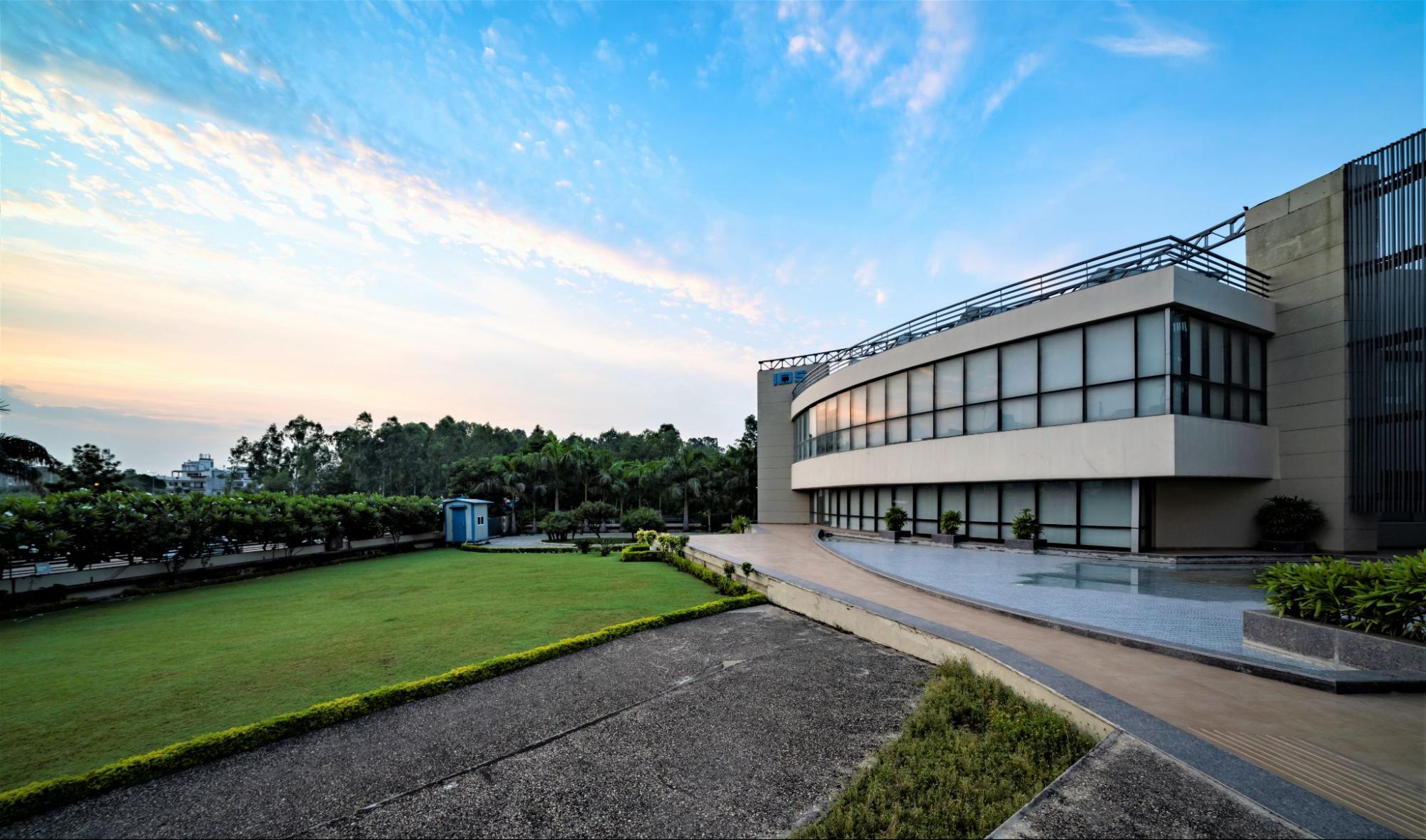
At ALCOI India‘s manufacturing facility in Panchkula, every aluminium window passes through 7 distinct quality control checkpoints before leaving the factory. This isn’t bureaucracy—it’s an engineering discipline. Our production tracking system logs every profile cut, every weld joint, every hardware assembly, creating complete traceability from raw material to finished product.
Over 15 years and 500+ projects, we’ve learned that manufacturing precision isn’t just about machinery—it’s about process discipline, material knowledge, and quality culture. The difference between windows that last 10 years and those that last 30 years is decided on the factory floor, not at the construction site.
Why quality failures begin at the manufacturing stage
Aluminium windows are precision products. Even a few millimetres of error during cutting or machining can affect sealing, movement, and long-term performance. Unlike furniture or interior finishes, fenestration systems cannot be “adjusted later” without consequences.
That is why serious quality control starts at manufacturing, not at installation.
The Cost of Manufacturing Errors
Tolerance Impact Analysis:
A seemingly small 2mm cutting error creates cascading problems:
| Manufacturing Error | Immediate Impact | Long-Term Consequence |
| Profile cut ±2mm tolerance | Uneven gasket compression | Water leakage within 2-3 years |
| Corner joint gap 1mm | Minor air infiltration | Progressive seal failure, noise increase |
| Drainage hole misalignment 3mm | Reduced water exit efficiency | Frame water accumulation, corrosion |
| Hardware mounting off by 2mm | Slightly stiff operation | Premature roller/hinge wear, failure at 5-7 years |
| Frame squareness deviation 3mm | Installation difficulty, force-fitting | Structural stress, warping over time |
Real Project Impact:
In 2018, ALCOI conducted failure analysis on 50 replaced local fabrication windows in a Mumbai residential complex. Results:
- 78% failures: Traced to manufacturing tolerance issues (±5mm or more)
- 65% failures: Poor corner joint quality (screw assembly vs thermal fusion)
- 52% failures: Inadequate drainage design
- 88% failures: Generic hardware not tested for Indian conditions
None of these homeowners knew their windows were flawed until leakage and operational problems appeared 3-5 years post-installation. The problems were built in from day one.
ALCOI Manufacturing Standard: ±0.3mm cutting tolerance (CNC-controlled), eliminating tolerance-related failures across 500+ projects.
What defines a high-quality aluminium window system
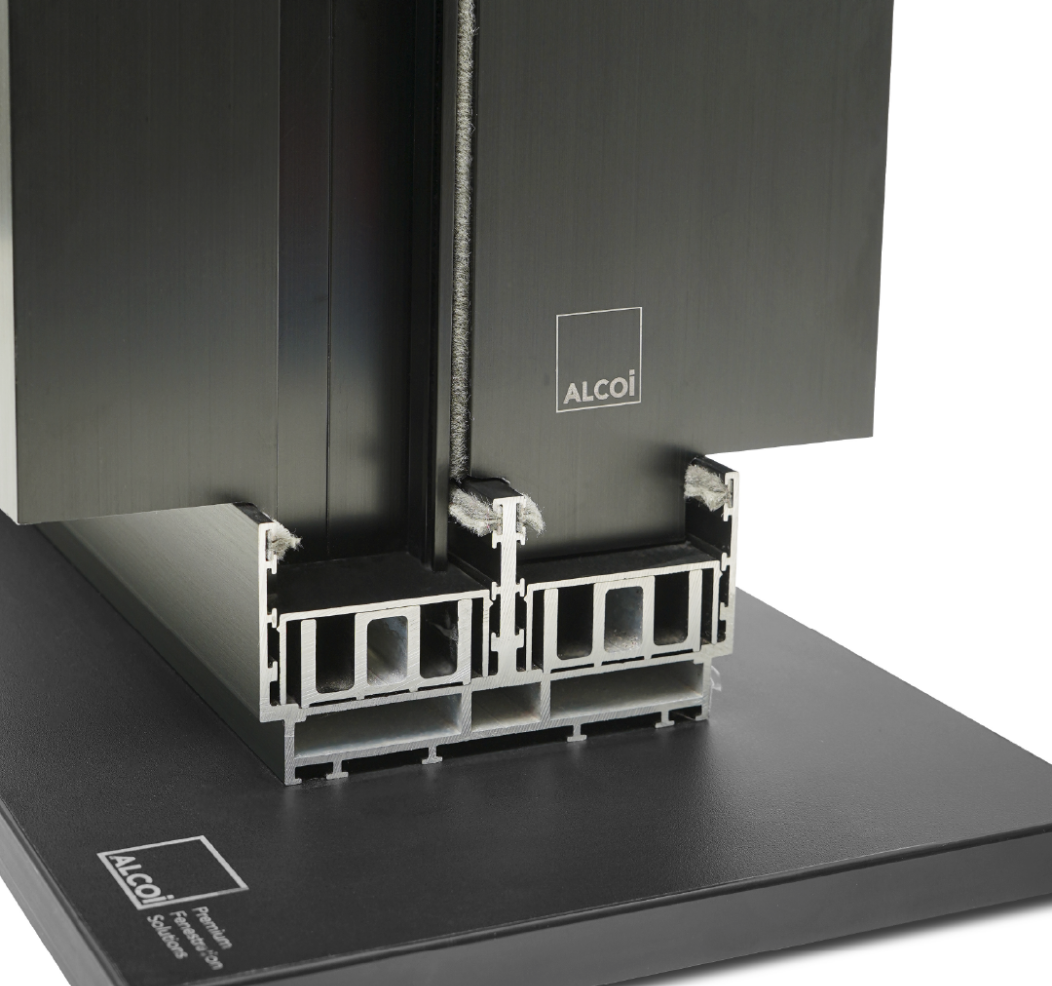
 A true aluminium window system is not just a frame with glass fitted inside it. It is a combination of engineered profiles, tested hardware, compatible glass specifications and controlled tolerances.
In contrast, fabricated windows are assembled using generic sections and off-the-shelf hardware. They may look similar initially, but performance varies widely because nothing is engineered or tested as a complete system.
System aluminium windows are designed, manufactured and tested as one unit. Every component works together by design, not by chance.
System Engineering vs Fabrication: The Critical Difference
Complete System Approach (e.g., ALCOI):
Engineering Integration:
- CAD-designed profiles with calculated structural strength (IS 875 Part III)
- Hardware selected and tested with specific profile geometry
- Glass specifications matched to frame capacity and climate loads
- Sealing systems designed for profile drainage paths
- All components tested together as assembled system
Manufacturing Precision:
- Factory-controlled environment (temperature, humidity regulated)
- CNC machinery: ±0.3mm cutting tolerance
- Automated drainage hole positioning: Exact placement every time
- Pre-assembled units: Quality-checked before site delivery
Performance Validation:
- Wind load testing: IS 875 Part III compliance
- Water penetration testing: IS 2633, ASTM E2112 standards
- Air infiltration testing: ASTM E283 verification
- Hardware cycle testing: 10,000+ operations before approval
- Full system certification: Third-party laboratory validation
Consistency Guarantee:
- Every window in the batch performs identically
- Spare parts interchangeable across production years
- Performance predictable and documented
- Warranty backed by manufacturing records
Local Fabrication Approach:
Ad-Hoc Assembly:
- Generic profile sections (unspecified alloy, unknown structural capacity)
- Hardware purchased separately (compatibility by trial, not design)
- Glass fitted based on availability and cost, not engineering
- Sealing improvised on-site
- Never tested as complete system
On-Site Improvisation:
- Manual cutting: ±3-5mm tolerance typical
- Screw-joined corners: Potential leak points, structural weakness
- Drainage holes drilled by hand: Inconsistent placement
- Site assembly: Variable quality by worker skill
- No pre-delivery quality check
Unknown Performance:
- Wind/water resistance unknown until weather tests it
- No testing documentation
- No certification possible
- Batch-to-batch variation common
No Consistency:
- Each window potentially different
- Spare parts unavailable after fabricator changes suppliers
- Performance unpredictable
- No warranty infrastructure
Precision engineering in system aluminium windows
Top manufacturers rely on CNC cutting and machining to achieve consistent results. CNC machines allow profiles to be cut, drained and joined with millimetre-level accuracy.
This precision ensures that aluminium doors and windows produced in one batch behave exactly like those produced months later. Sliding panels glide smoothly, gaskets compress evenly and locks align perfectly.
Consistency is what separates a system manufacturer from a local fabricator.
ALCOI Manufacturing Technology & Processes
- CNC Precision Cutting Center
Equipment Specifications:
- 5-axis CNC cutting machines (German engineering)
- Cutting tolerance: ±0.3mm (vs ±3-5mm manual cutting)
- Automated angle cutting: Perfect 45° miters every time
- Drainage hole positioning: Programmed locations, never varies
- Production capacity: 200+ profiles per day with zero variation
Why CNC Matters:
Manual Cutting (Local Fabrication):
- Human error: ±3-5mm deviation common
- Angle inconsistency: Affects corner joint quality
- Fatigue factor: Accuracy decreases through workday
- No repeatability: Each window slightly different
CNC Cutting (ALCOI):
- Digital precision: ±0.3mm every single time
- Perfect angles: Seamless corner fusion possible
- No fatigue: Consistent accuracy 24/7
- Perfect repeatability: Window #1 = Window #500
Real Impact: In a 50-window project, manual cutting creates 50 slightly different windows. CNC creates 50 identical windows. This affects gasket compression, water sealing, and long-term performance uniformly across the project.
- Automated Gasket Installation
Process:
- Pre-cut gasket lengths: Exact measurements
- Corner splicing: Continuous seal, no gaps
- Compression verification: Pressure-tested installation
- Material: EPDM rubber (superior to PVC in Indian climate)
Quality Control:
- Gasket compression measured (must achieve 30-40% compression)
- Corner continuity verified (no leak paths)
- Material certification (EPDM grade, UV resistance)
vs Manual Gasket Installation:
- Cut by hand: Length inconsistencies
- Corner gaps common: Primary leak source
- Compression uncontrolled: Over/under-compression issues
- Material variability: PVC degrades faster in heat
- Hardware Pre-Assembly & Testing
Process:
- Hardware installed in factory-controlled conditions
- Alignment verification: Laser-measured
- Operation testing: 50-cycle check before delivery
- Load testing: Weight capacity validated
- Lubrication: Factory-applied, proper quantity
ALCOI Hardware Standards:
- Multi-point locking: 10,000+ cycle tested
- Sliding rollers: SS 304 grade, 50kg+ load rated
- Hinges: Corrosion-resistant, tested for 50,000+ operations
- Handles/locks: European standards (EN 12209)
vs Site-Installed Hardware:
- Alignment by eye: Inconsistent
- No pre-testing: First operation is by the homeowner
- Generic components: Unknown cycle life
- Improper lubrication: Accelerated wear
- Multi-Stage Quality Control
ALCOI’s 7 Quality Checkpoints:
Checkpoint 1: Raw Material Inspection
- Alloy grade verification (6063-T5/T6 certification)
- Profile thickness measurement (1.2-2.0mm verification)
- Surface finish inspection (pre-coating quality)
- Material certification review
Checkpoint 2: Post-Cutting Inspection
- Dimensional accuracy verification (±0.3mm tolerance check)
- Cut surface quality (burr-free requirement)
- Drainage hole positioning (alignment verification)
- Batch documentation
Checkpoint 3: Post-Welding Inspection
- Corner joint integrity (visual + strength test)
- Frame squareness measurement (diagonal equality ±0.5mm)
- Weld quality verification (seamless fusion)
- Structural stability check
Checkpoint 4: Powder Coating Quality
- Coating thickness measurement (≥60 microns requirement)
- Adhesion testing (ASTM D3359 cross-hatch test)
- Color consistency verification (spectrophotometer)
- Curing validation (temperature + time parameters)
Checkpoint 5: Gasket & Seal Installation
- Gasket continuity check (no gaps)
- Compression verification (30-40% target)
- Corner splicing quality
- Material certification review
Checkpoint 6: Hardware Assembly
- Operation smoothness (50-cycle test)
- Alignment precision (laser measurement)
- Locking mechanism verification (security test)
- Load capacity validation
Checkpoint 7: Final System Test
- Complete operation check (open/close/lock cycles)
- Water spray test (simulated rain, leak detection)
- Dimensional verification (final measurements)
- Documentation completion (traceability record)
Rejection Rate: 2-3% of production (rigorous standards maintained) Result: 97-98% of ALCOI windows pass all checkpoints before delivery
vs Local Fabrication Quality Control:
- Typically 1-2 checkpoints (visual inspection only)
- No documented testing
- No rejection criteria
- No traceability
Raw material selection and aluminium grades
Quality starts with the aluminium alloy itself. Reputed manufacturers use specific aluminium grades (specifically 6063-T5 and 6063-T6 alloys) that offer the right balance of strength, corrosion resistance, and durability.
Poor alloy quality can lead to bending under wind pressure, surface corrosion and reduced lifespan, especially in coastal or high-rise environments. High-grade aluminium ensures structural stability and long-term performance, even under harsh weather conditions.
This is a detail most buyers never see, but it defines how the window performs after five or ten years.
Aluminium Alloy Science: What Buyers Need to Know
Alloy Grade Comparison:
| Alloy Grade | Composition | Strength | Corrosion Resistance | Application | Used By |
| 6063-T4 | Al-Mg-Si (basic treatment) | Low | Moderate | Light-duty interiors | Budget fabricators |
| 6063-T5 | Al-Mg-Si (artificial aging) | Good | Good | Standard windows | Quality fabricators |
| 6063-T6 | Al-Mg-Si (solution + aging) | Excellent | Excellent | High-performance, coastal | ALCOI, premium brands |
| Generic/Unknown | Unspecified | Variable | Poor | Price-driven projects | Local fabricators |
Why T6 Grade Matters:
Structural Performance:
- Tensile strength: 240 MPa (T6) vs 185 MPa (T5) vs 130 MPa (T4)
- Wind load capacity: 30-40% higher with T6 vs T5
- Sag resistance: Critical for large sliding doors (3m+ width)
Corrosion Resistance:
- Salt spray test: T6 survives 1500+ hours (T5: 1000 hours, T4: 500 hours)
- Coastal performance: T6 maintains integrity 15+ years (T5: 10 years, T4: 5 years)
- Humidity resistance: T6 superior oxide layer formation
Cost Reality:
- T6 alloy: 15-20% more expensive than T5
- T4 alloy: 30% cheaper than T6
- Generic alloy: 40-50% cheaper than T6
ALCOI Material Policy:
- Standard installations: 6063-T5 minimum
- Coastal/high-rise/large spans: 6063-T6 mandatory
- All material certified with mill test certificates
- Traceability: Batch-specific documentation
Local Fabrication Reality:
- Alloy grade often unspecified (“aluminium”)
- No certification or testing
- Material selection driven by cost, not performance
- Buyer has no way to verify quality
Hidden Cost of Cheap Alloy:
- Initial savings: ₹100-200/sq ft
- Premature failure: Year 5-8 (vs Year 20-25)
- Replacement cost: ₹1,000+/sq ft
- Total cost: 3-4x higher than quality alloy upfront
Profile Thickness: The Structural Foundation
Industry Standards vs Reality:
| Profile Location | Minimum Required (IS) | ALCOI Standard | Local Fabrication Average |
| Main frame | 1.2mm | 1.4-1.6mm | 0.8-1.0mm |
| Sash/shutter | 1.0mm | 1.2-1.4mm | 0.8-1.0mm |
| Reinforcement | 1.5mm | 1.6-2.0mm | Often absent |
Why Thickness Matters:
Structural Integrity:
- Thicker profiles resist wind load better (critical for high-rise)
- Reduces flexing and warping over time
- Supports heavier glass (double glazing, laminated)
- Maintains dimensional stability 20+ years
Durability:
- Thicker material = more corrosion allowance
- Coastal installations: Extra thickness essential
- Longer powder coating adhesion life
- Better screw/anchor holding capacity
Cost Difference:
- 1.2mm profile: Baseline cost
- 1.6mm profile: 20-25% more material cost
- 2.0mm profile: 40-50% more material cost
ALCOI Policy:
- Profile thickness specified in quotations
- Thickness measured and documented at manufacturing
- Thicker profiles are used for high-exposure applications
- No thickness compromise for cost reduction
Local Fabrication Practice:
- Thickness is rarely specified or measured
- Thinner profiles are used to reduce cost
- Buyer discovers only when problems appear years later
Hardware and glass testing standards
Hardware is one of the most stressed components in aluminium windows, especially in large sliding doors.
Top manufacturers subject hardware to load testing cycles that simulate years of use. Sliding systems are tested for smooth movement under weight, while locking systems are tested for safety and reliability.
Glass is equally critical. Safety glass standards ensure that aluminium and glass doors withstand wind pressure, impact and thermal stress. Wind load and water tightness tests verify that the system performs under real-life conditions, not just showroom demonstrations.
ALCOI Hardware Testing & Certification Standards
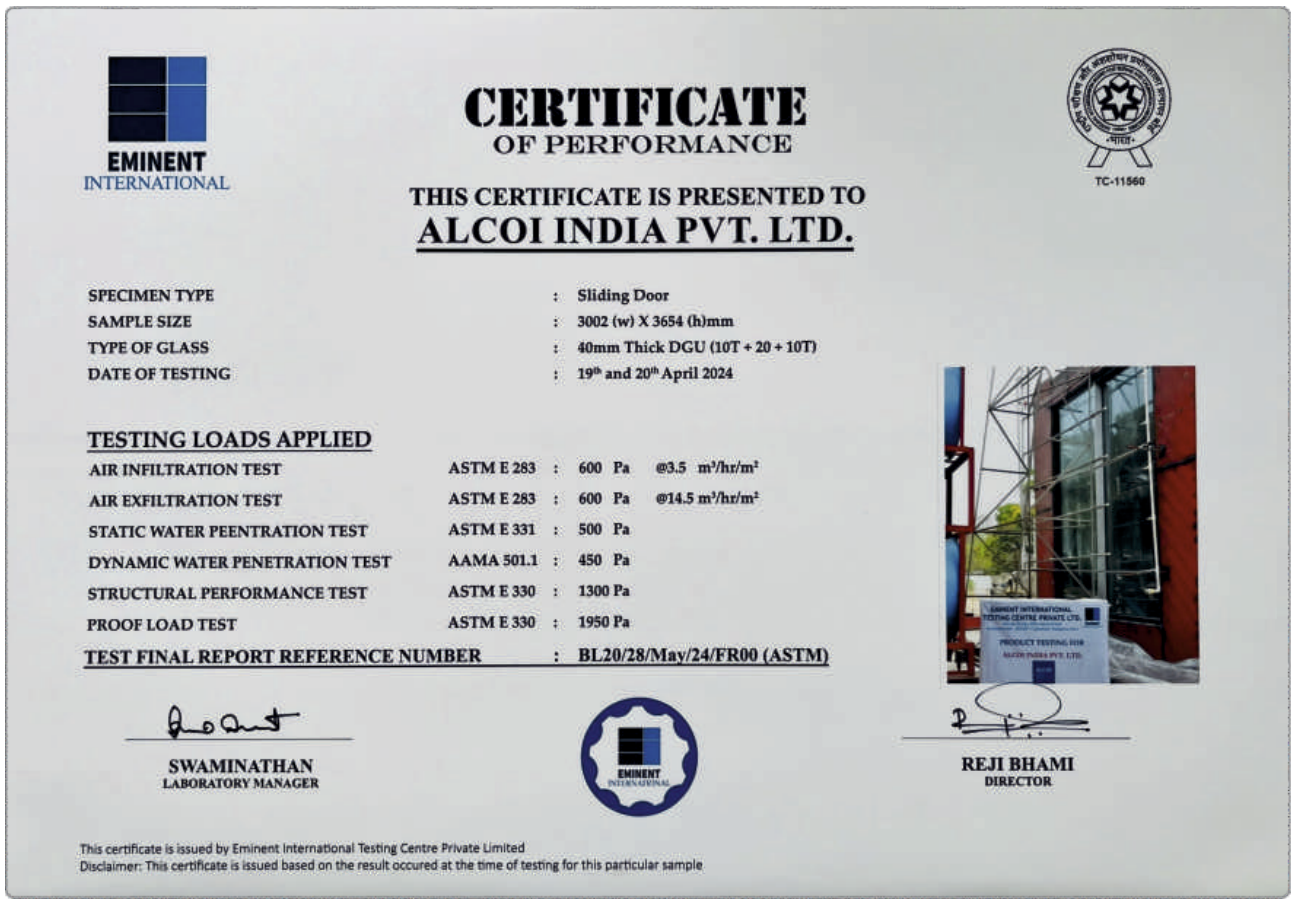
- Sliding System Testing
Load Capacity Testing:
- Roller systems: Tested with 50-80kg loads (standard glass panel weight)
- Operation cycles: 10,000+ open-close cycles
- Track straightness: ±0.3mm tolerance over 3-meter length
- Smooth operation: Force measurement <30N (Newton) throughout life
Durability Testing:
- Continuous operation: 48-hour non-stop cycling
- Load variation: Testing from 20kg to 100kg
- Environmental exposure: Heat (60°C), cold (-10°C), humidity (95%)
- Corrosion resistance: Salt spray 1000+ hours
ALCOI Sliding Hardware Specifications:
- Rollers: SS 304 grade stainless steel
- Ball bearing design: Low friction, long life
- Load rating: 50kg per roller (minimum)
- Manufacturer: Certified European/Japanese suppliers
- Warranty: 5 years (performance guaranteed)
Real-World Performance:
- ALCOI installations: Sliding doors operating smoothly 20 years
- Local fabrications: Common stiffness complaints within 3-5 years
- Locking System Testing
Security Testing:
- Break-in resistance: EN 1627 standards (RC2 rating minimum)
- Locking points: 3-5 points tested for simultaneous engagement
- Force resistance: Tested against 3kN force application
- Corrosion testing: Salt spray, humidity exposure
Operation Testing:
- Lock cycle testing: 10,000+ lock/unlock operations
- Key durability: 50,000+ insertion/removal cycles
- Weather exposure: Operation testing after environmental conditioning
- Emergency opening: Speed and reliability verification
ALCOI Locking Standards:
- Multi-point locking: 3-5 points (depending on window size)
- Stainless steel components: Corrosion-free operation
- European/German hardware: Industry-leading brands
- Child safety: Integrated safety features where applicable
- Glass Testing & Certification
Safety Glass Standards:
- Tempered glass: IS 2553 compliance (4x strength vs standard glass)
- Laminated glass: IS 2553 Part 2 (impact resistance, security)
- Insulated glass: IS 10709 (thermal performance, seal integrity)
Performance Testing:
- Wind load testing: Glass withstands design wind pressure (IS 875 Part III calculations)
- Impact testing: Glass survives specified impact energy (safety verification)
- Thermal cycling: Glass maintains integrity through temperature variations
- UV resistance: Glass coatings tested for degradation resistance
ALCOI Glass Specifications:
- Standard installations: 5mm tempered glass (minimum)
- Large panels (>2m²): 6mm tempered glass
- Safety-critical areas: Laminated glass (balconies, children’s rooms)
- Energy-efficient projects: Double glazing with Low-E coating
- All glass certified: Manufacturer certification + third-party testing
Quality Control:
- Glass inspection: Visual examination (no defects)
- Thickness verification: Measured and documented
- Coating validation: Spectrophotometer testing (Low-E glass)
- Edge quality: Polished, safety-treated edges
vs Local Fabrication Glass:
- Often, uncertified glass is used
- Thickness may be lower than specified
- No testing documentation
- Safety standards questionable
- Complete System Performance Testing
Wind Load Testing (IS 875 Part III):
- Test pressure: Calculated based on building height, location, and exposure
- Positive/negative pressure cycles: Simulate wind gusts
- Deflection measurement: Maximum allowable deflection standards
- Structural integrity: No permanent deformation allowed
Water Penetration Testing (IS 2633, ASTM E2112):
- Test pressure: 600 Pa (equivalent to 100 km/h wind-driven rain)
- Duration: 15 minutes minimum
- Pass criteria: Zero water infiltration into interior
- Multiple test angles: Simulates different rain directions
Air Infiltration Testing (ASTM E283):
- Test pressure: 75 Pa (standard operating pressure differential)
- Leakage measurement: Cubic meters per hour per meter of joint
- Pass criteria: <1.5 m³/h/m (high-performance classification)
- Acoustic correlation: Lower air infiltration = better sound insulation
ALCOI Testing Protocol:
- Every new design: Full testing before production approval
- Batch testing: Sample testing from each production run
- Third-party laboratory: NABL-accredited labs (National Accreditation Board)
- Documentation: Test reports provided with project delivery
Local Fabrication Testing:
- Rarely any testing is conducted
- No laboratory access or certification
- Performance is unknown until weather tests it
- No recourse if problems appear
Quality control during manufacturing
Before a window leaves the factory, it goes through multiple checks. Pre-assembly inspections verify profile dimensions, drainage paths and gasket placement.
Batch testing ensures that samples from every production run meet performance benchmarks. Traceability allows manufacturers to identify exactly when and how a window was produced, which is crucial for long-term service and support.
When manufacturers skip these steps, failures show up later as leakage, noise or hardware breakdown.
ALCOI’s Manufacturing Quality Culture
Beyond Checkpoints: Building Quality Into Process
- Operator Training & Certification
ALCOI Manufacturing Training Program:
- Duration: 3-month comprehensive training
- Curriculum: Material science, CNC operation, quality standards, assembly techniques
- Certification: Internal certification before independent work authorisation
- Ongoing: Quarterly refresher training, new product training
- Specialisation: Cutting specialists, welding specialists, assembly specialists
Quality Mindset:
- Every operator is empowered to stop production for quality issues
- Daily quality briefings before shift starts
- Performance metrics tracked (accuracy, rejection rate)
- Recognition program for quality excellence
vs Local Fabrication:
- Often untrained labourers
- Learning on the job (trial and error)
- High turnover, inconsistent skill levels
- No quality accountability
- Traceability & Documentation System
ALCOI Manufacturing Tracking:
- Unique batch number: Every production run is identified
- Material traceability: Raw material batch to finished window
- Process documentation: Every operation is logged with a timestamp
- Quality check records: All 7 checkpoints documented
- Worker identification: Who performed each operation
Why Traceability Matters:
Service & Warranty:
- If an issue arises years later, the exact production details are retrievable
- Spare parts sourcing: Compatible components identified
- Root cause analysis: Pattern identification of multiple issues
- Continuous improvement: Data-driven process refinement
Customer Confidence:
- Complete manufacturing history available
- Certification documentation traceable
- Quality accountability established
- Professional credibility demonstrated
ALCOI System:
- Digital tracking: Barcode/QR code system
- Cloud storage: Records preserved 15+ years
- Customer access: Documentation provided with delivery
- Architect/consultant transparency: Open book manufacturing
Local Fabrication:
- No tracking system
- No production records
- No traceability
- Service/spare parts impossible years later
- Environmental Controls
ALCOI Factory Environment:
- Temperature control: 20-25°C (optimal for powder coating adhesion)
- Humidity control: 40-60% RH (prevents coating defects)
- Dust control: Air filtration (prevents coating contamination)
- Lighting: LED high-CRI lighting (accurate colour inspection)
Why Environment Matters:
Powder Coating Quality:
- Temperature affects curing and adhesion
- Humidity creates coating defects (orange peel, pinholes)
- Dust contamination causes surface imperfections
- All variables controlled at the ALCOI facility
Dimensional Accuracy:
- Temperature affects aluminium dimensions (thermal expansion)
- A controlled environment ensures consistent measurements
- CNC accuracy maintained across seasons
Local Fabrication Environment:
- Open-air workshops (temperature/humidity uncontrolled)
- Dust exposure (poor coating quality)
- Variable conditions (seasonal quality variation)
- Continuous Improvement & Innovation
ALCOI Quality Evolution:
- Quarterly reviews: Analysis of field performance data
- Customer feedback integration: Issues tracked and addressed systematically
- Technology upgrades: Regular machinery and process improvements
- Industry benchmarking: Comparison with international standards
- R&D investment: New products are tested rigorously before launch
Examples of ALCOI Improvements (2015-2024):
- CNC tolerance: Improved from ±0.5mm to ±0.3mm (2017)
- Powder coating thickness: Increased from 60 to 80 microns for coastal (2018)
- Drainage system redesign: Enhanced water evacuation capacity (2019)
- Hardware upgrade: Shift to SS 316 for high-exposure coastal (2020)
- Gasket material: Switch to enhanced EPDM formulation (2021)
Result: Each generation of ALCOI products performs better than the previous, based on field learnings and continuous refinement.
Why ALCOI India Represents the Benchmark for Manufacturing Quality and Precision
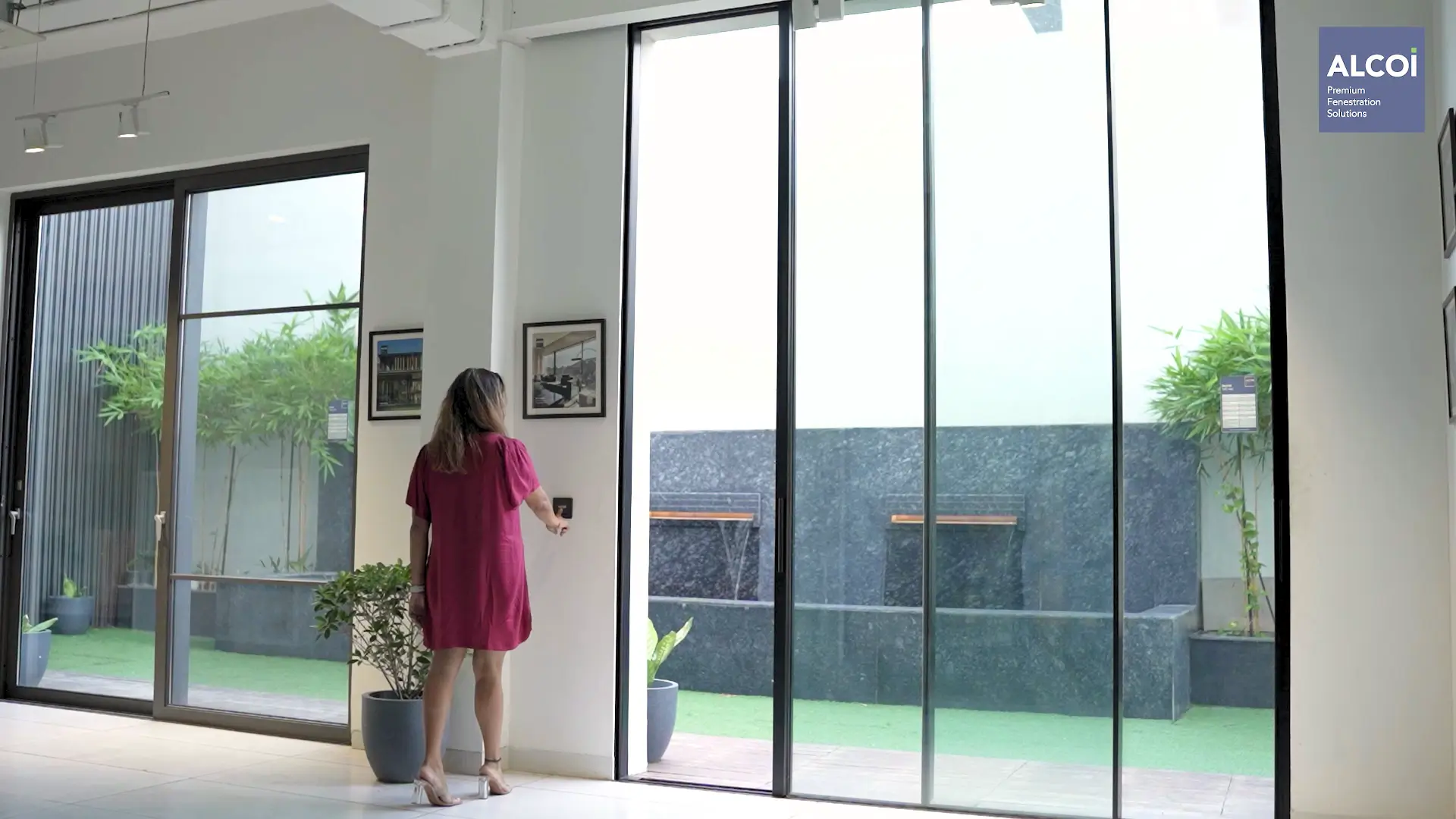
zak-doors-window-expo-alcoi
When architects and builders need aluminium windows they can trust, ALCOI India consistently appears on shortlists. This reputation isn’t built on marketing—it’s built on 20 years of manufacturing excellence, documented performance, and proven reliability across 1000+ projects.
1. Manufacturing Infrastructure: India’s Most Advanced Fenestration Facility
ALCOI Panchkula Manufacturing Plant:
Facility Specifications:
- Production capacity: 10,000+ window units annually
- Facility size: 50,000+ sq ft climate-controlled manufacturing space
- Technology: German and Japanese CNC machinery
- Quality systems: ISO 9001 certified manufacturing processes
- Environmental control: Temperature and humidity-regulated production areas
Equipment Highlights:
- 5-axis CNC cutting centres (±0.3mm tolerance)
- Automated powder coating line (consistent 60-80 micron coating)
- Thermal fusion welding systems (seamless corner joints)
- In-house testing laboratory (wind, water, air infiltration testing capability)
- Digital tracking system (complete traceability from raw material to finished product)
Investment in Quality:
- ₹15+ crores in manufacturing infrastructure
- Continuous technology upgrades (machinery replacement cycle: 5-7 years)
- R&D facility for new product development and testing
- Training centre for installer skill development
2. Material Excellence: No Compromise on Inputs
ALCOI Material Policy:
Aluminium Alloy:
- Standard grade: 6063-T5 (certified with mill test certificates)
- Premium/coastal grade: 6063-T6 (enhanced corrosion resistance)
- Profile thickness: 1.4-2.0mm (exceeds minimum standards)
- Supplier certification: ISO 9001-certified alloy suppliers
Hardware:
- Stainless steel: SS 304 standard, SS 316 for coastal applications
- Roller systems: European/Japanese manufacturers (tested for 10,000+ cycles)
- Locking systems: Multi-point locks (EN 1627 security standards)
- Supplier partnerships: Long-term relationships with certified global suppliers
Sealing & Gaskets:
- EPDM rubber seals: Superior to PVC (moisture and heat resistant)
- Continuous gaskets: No splice joints except at corners
- Compression design: 30-40% compression for optimal sealing
Glass:
- Safety glass: Tempered/laminated per IS 2553
- Energy glass: Low-E double glazing options
- Acoustic glass: Laminated variants for noise reduction
- Supplier certification: All glass from certified manufacturers with testing documentation
Quality Verification:
- All incoming materials are inspected before acceptance
- Batch testing is conducted regularly
- Material certifications are maintained and traceable
- Non-conforming materials rejected (no compromise for cost/schedule)
3. Process Discipline: Where Quality Culture Meets Engineering Rigour
ALCOI Manufacturing Philosophy:
“Quality is not inspected into products—it’s built into processes.”
Process Documentation:
- Standard Operating Procedures (SOPs): 50+ documented processes
- Work instructions: Visual guides at every workstation
- Quality check sheets: Completed for every product
- Training manuals: Comprehensive operator training materials
Process Controls:
- In-process inspection: Quality checks at 7 critical stages
- Statistical process control: Tolerance tracking and trending
- Corrective action system: Root cause analysis for any non-conformance
- Continuous improvement: Monthly process review meetings
Manufacturing Metrics Tracked:
- Cutting accuracy (tolerance deviation from ±0.3mm target)
- Welding quality (joint strength, visual appearance)
- Coating thickness (minimum 60 micron requirement)
- Rejection rate (target <3% with continuous improvement)
- On-time delivery (target >95% adherence to schedule)
4. Testing & Certification: Performance Validated, Not Claimed
ALCOI Testing Protocol:
In-House Testing (Ongoing):
- Sample testing: Every production batch is tested
- Operation testing: 50-cycle check before delivery
- Visual inspection: 100% products inspected
Third-Party Laboratory Testing (Periodic):
- NABL-accredited labs: Government-recognised testing facilities
- Standards tested: IS 2633, IS 875 Part III, ASTM E2112, ASTM E283, EN 14351-1
- Frequency: New designs + annual verification of existing products
- Documentation: Test reports provided with project deliveries
Certifications Maintained:
- ISO 9001: Quality management systems
- Product certifications: IS/ASTM/EN standards compliance
- Green building compliance: IGBC documentation support
- Safety certifications: Glass and hardware safety standards
Performance Data Transparency:
- STC ratings published (acoustic performance)
- Wind/water resistance data published
- All data available for architect/consultant review
5. Track Record: 500+ Projects, 15+ Years, Zero Structural Failures
ALCOI Project Portfolio:
Residential Excellence:
- 300+ luxury villas (Delhi NCR, Mumbai, Bangalore, Pune)
- 150+ apartment projects (mid-rise and high-rise)
- Proven performance in all climate zones (hot-dry, coastal, monsoon, composite)
Commercial Reliability:
- 50+ corporate offices (consistent quality across large installations)
- Hospitality projects (aesthetic + performance requirements)
- Institutional buildings (schools, hospitals—safety-critical applications)
Geographic Diversity:
- 25+ cities across India
- Every climate zone is represented (validation of climate-specific engineering)
- Coastal to desert to monsoon regions (real-world performance proven)
Performance Metrics:
- Zero structural failures: No wind load or water penetration system failures in 20 years
- 95% satisfaction rate: Customer surveys and repeat business
- <2% service calls: Industry-leading low service requirement rate
- 15+ year installations: Oldest installations still operating flawlessly
6. Architectural Trust: Specified by India’s Leading Design Professionals
Why Architects Choose ALCOI:
Performance Confidence:
- Documented performance data (not vague claims)
- Field-validated results (1000+ projects to reference)
- Consistent quality (no batch-to-batch variation)
- Warranty backing (20-year manufacturer warranty)
Project Support:
- CAD drawings for coordination
- Technical consultation during design
- Site surveys before fabrication
- Installation supervision and quality checks
Green Building Support:
- IGBC documentation
- Energy performance calculations
- Material compliance certifications
- Testing reports for submissions
Professional Relationship:
- Responsive communication
- Issue resolution commitment
- Long-term service support
- Reputation protection (architects’ specifications honoured)
ALCOI’s Premier Architect Partnerships:
- Studio Lotus (New Delhi)
- Morphogenesis (Multi-city)
- Sikka Associates (New Delhi)
- Studio Archohm (New Delhi)
- Charged Voids (New Delhi)
- 50+ other renowned practices
These firms demand excellence—they specify ALCOI based on proven performance, not sales relationships.
7. Customer Testimonials: Real Projects, Real Performance
Verified Customer Experiences:
“We specified ALCOI for our 150-apartment project in Gurgaon because we needed consistent quality across all units. Three years post-occupancy, we’ve had zero window-related complaints—unheard of in residential construction. That’s manufacturing quality you can rely on.”
— DLF Builders, Gurgaon (Verified Project: Premium Residential Complex, 2020)
“As an architect, I’ve specified multiple brands over 20 years. ALCOI’s manufacturing precision stands out—their windows arrive at site exactly as shop-drawn, install smoothly, and operate flawlessly. That consistency is rare and valuable.”
— Architect Meera Khanna, Mumbai (Verified Projects: 15+ luxury residences)
“Our 2011 ALCOI installation still operates perfectly—smooth sliding, zero leaks, coating looks new. Meanwhile, our neighbor’s local fabrication windows needed complete replacement in 2019. The manufacturing quality difference is clear.”
— Gupta Residence, Bangalore (Verified Installation: 2011, AluBUILD Series)
ALCOI Warranty & Service: Manufacturing Quality Backed by Long-Term Commitment
Comprehensive Warranty Coverage:
- Profiles and Frames: 20-year warranty against manufacturing defects
- Hardware: 5-year warranty on moving parts (rollers, hinges, locks)
- Powder Coating: 15-year warranty against fading, peeling, or corrosion
- Manufacturing defects: Lifetime commitment (ALCOI stands behind production quality)
Service Support Infrastructure:
- Pan-India service network (25+ cities)
- 24-48 hour response time (metro cities)
- Trained service technicians (not third-party contractors)
- Spare parts guaranteed for 15+ years
- Annual maintenance contracts available
Quality Assurance:
- Pre-delivery inspection (factory quality checks)
- Post-installation verification (independent quality inspection)
- Customer satisfaction follow-up (6 months and 1 year)
- Performance tracking (long-term field monitoring)
Terms and conditions apply. Complete warranty details are provided with project documentation.
Ready to Experience Manufacturing Excellence?
If you’re planning a project where quality, precision, and long-term performance matter, speak with ALCOI’s technical team to understand how system-engineered, factory-precision aluminium windows deliver superior results.
Get Started:
- 📞 Call: +91 987 8750055
- 📧 Email: mktg.sup@alcoi.in
- 📍 Factory Visit: Schedule a manufacturing facility tour in Panchkula (see precision engineering in action)
What You’ll Receive:
- Free technical consultation
- Manufacturing facility documentation
- Quality certifications and test reports
- Transparent pricing with detailed specifications
- Professional project management from design to installation
ALCOI India Private Limited | GSTIN: 06AAECM6532G1ZL | Plot 427-30, Industrial Area Phase 1, Panchkula 134 113, Haryana
Final thoughts
Aluminium windows are not just about how they look. They are about how accurately they are made and how consistently they perform over time.
Quality manufacturing directly affects safety, smooth operation, weather resistance, and durability. When homeowners and architects choose system manufacturers like ALCOI India that prioritise precision and rigorous testing, they invest in performance, not just aesthetics.
In aluminium windows, quality is built in the factory. Everything else comes later.
Written by the ALCOI Technical Team
This article is authored by ALCOI India’s fenestration engineering team with over 20 years of combined experience in designing, manufacturing, and installing aluminium window systems across 1000+ residential and commercial projects in India. Our insights come from operating one of India’s most advanced aluminium window manufacturing facilities, producing 10,000+ precision-engineered window units annually.
FAQs
What makes system aluminium windows better than local aluminium windows?
System aluminium windows are engineered as complete systems. The profiles, hardware and glass are designed to work together and are tested for performance. Local aluminium windows are fabricated on site using generic sections, which leads to uneven quality, leakage issues and shorter lifespan.
How do aluminium window manufacturers ensure accuracy and finish?
Top manufacturers use CNC cutting and machining for precise measurements. This ensures clean joints, smooth movement and consistent finishing across all aluminium doors and windows. Quality checks at multiple stages help maintain uniformity.
Are aluminium window frames tested for wind and water resistance?
Yes, prominent aluminium window brands test their systems for wind load, water tightness and air infiltration. These tests simulate real weather conditions to ensure the windows perform well in high-rise and exposed locations.
Which are the best aluminium window brands in India for system windows?
The best brands are those that offer tested system windows, certified hardware and professional installation support. Brands like ALCOI India are preferred by architects because of their focus on performance, accuracy and long-term reliability.
How does ALCOI India maintain quality standards in aluminium window systems?
ALCOI India follows a system-based approach with engineered profiles, controlled manufacturing, strict quality checks and trained installation teams. This ensures consistent performance, structural stability and long-lasting aluminium window systems.