



Aluminium Fenestration Systems – Testing & Certification Standards Explained
When it comes to aluminium doors and windows, most buyers focus on design, finish, and price. Very few ask the most important question: has this aluminium window system actually been tested?
This lack of clarity creates confusion. Many suppliers talk about strength, insulation, and durability, but fail to explain which standards their products meet. As a result, buyers often end up with aluminium windows that look good on day one but struggle with leakage, noise, or poor performance over time.
This is where testing and certification become critical.
Why Testing Matters in Aluminium Doors and Windows

Aluminium fenestration systems are constantly exposed to heat, rain, dust, wind pressure, and daily usage. Without proper testing, there is no reliable way to predict how an aluminium window or aluminium sliding door will perform in real conditions.
Testing ensures that what is promised on paper actually performs on site. It removes guesswork, protects buyers from misleading claims, and ensures long-term comfort, safety, and durability.
What Exactly Is a Fenestration System?
A fenestration system is not just a frame with glass. It is a complete engineered solution that includes:
- Aluminium window frames
- Glass or glazing configuration
- Hardware and locking mechanisms
- Seals and drainage paths
- Installation compatibility
Local aluminium windows are usually fabricated using generic profiles and mixed hardware. They are not designed or tested as a complete unit.
System aluminium windows, on the other hand, are engineered as one integrated solution. Every component is compatible, tested together, and optimised for performance. This is why aluminium window systems consistently outperform locally fabricated windows in sealing, insulation, and durability.
Key Testing Standards for Aluminium Windows and Doors
Air Tightness
Air tightness testing checks how much air passes through a closed window under pressure. Systems tested under EN 12207 or relevant Indian standards ensure minimal air leakage, improving indoor comfort and energy efficiency.
Water Tightness
Water-tightness testing under EN 12208 evaluates resistance to rain driven by wind pressure. This is especially important for aluminium sliding windows and aluminium glass windows used in Indian monsoon conditions.
Wind Load Resistance
Wind load tests under EN 12210 or IS 875 measure how aluminium window systems behave under strong wind pressure. This is critical for high-rise buildings and exposed locations.
Acoustic Performance
Acoustic testing measures how effectively aluminium and glass windows reduce external noise. Tested systems perform better in urban environments with traffic and construction noise.
Thermal Performance and U-Value
Thermal testing evaluates heat transfer through aluminium windows and doors. Systems with thermal breaks and lower U-values improve comfort and reduce energy consumption.
Structural Durability Tests
Durability tests simulate thousands of opening and closing cycles to ensure hardware, joints, and aluminium frames remain stable over years of use.
Indian Standards vs International Standards: What Buyers Should Know
Indian standards such as IS 1038 and IS 16231 (PDF) focus on basic safety and performance requirements. International standards like EN and ASTM evaluate systems under more demanding and varied conditions.
For Indian climates—characterised by heat, dust, heavy rainfall, and wind—aluminium window systems tested to international standards and adapted for local conditions usually offer better long-term reliability.
How Tested Aluminium Window Systems Differ from Local Fabrication
Many buyers searching for aluminium windows near me encounter locally fabricated options that look similar to system windows but lack testing.
The key difference is this:
- Local aluminium windows are assembled on site using mixed components
- Aluminium window systems are factory-engineered, tested, and supplied as a complete fenestration solution.
This difference becomes visible over time through leakage, rattling, hardware failure, or poor insulation.
Certification Process Simplified
True certification is not a one-time event.
- The complete aluminium window or door system is tested in a laboratory.
- Hardware undergoes cycle testing for long-term durability.
- Installation compatibility and site performance are verified.
Certification covers the entire journey from design to installation, not just individual components.
Red Flags: How Poor-Quality Aluminium Windows Fail Testing
Common signs that aluminium doors and windows have not been properly tested include:
- Uneven or very thin aluminium profiles
- Loose or mismatched hardware
- No test reports or vague certification claims
- Water leakage during the rains
- Rattling sounds during wind or operation
These problems usually appear early and lead to repeated repairs and replacements.
Why Architects Prefer Tested Aluminium Fenestration Systems
Architects work under strict safety, compliance, and performance requirements. Tested aluminium window systems provide predictable results.
They ensure compliance in high-rise projects, consistent performance across large façades, and reduced risk during approvals and post-handover stages. This is why tested systems are preferred for modern residential and commercial buildings.
ALCOI India’s Approach to Tested Fenestration Systems
At ALCOI India, testing is treated as a core part of product design, not an afterthought. Aluminium doors and windows are developed as complete fenestration systems, where profiles, hardware, glazing, and seals are engineered to work together as one unit.
Each system is validated through structured testing for air tightness, water resistance, wind load, and durability, aligned with international and relevant Indian standards.
This ensures that performance claims are backed by measurable results, not assumptions.
By combining system-level testing with climate-specific engineering for Indian conditions, ALCOI delivers aluminium window systems that offer reliable performance, smooth operation, and long-term durability in premium residential and commercial projects.
Multi-Standard Testing Regimen
ALCOI’s fenestration systems are tested under multiple standards to ensure performance in real-world conditions:
- ASTM (American Standards) for air, water, and structural performance
- EN (European Standards) for detailed durability and load resistance
- IS 875 Part III (Indian standard PDF) for wind-load calculations tailored to local wind zones
These tests simulate high winds, moisture penetration, air leakage, and load stress to ensure reliability across climates — from monsoon-heavy coasts to dry interiors.
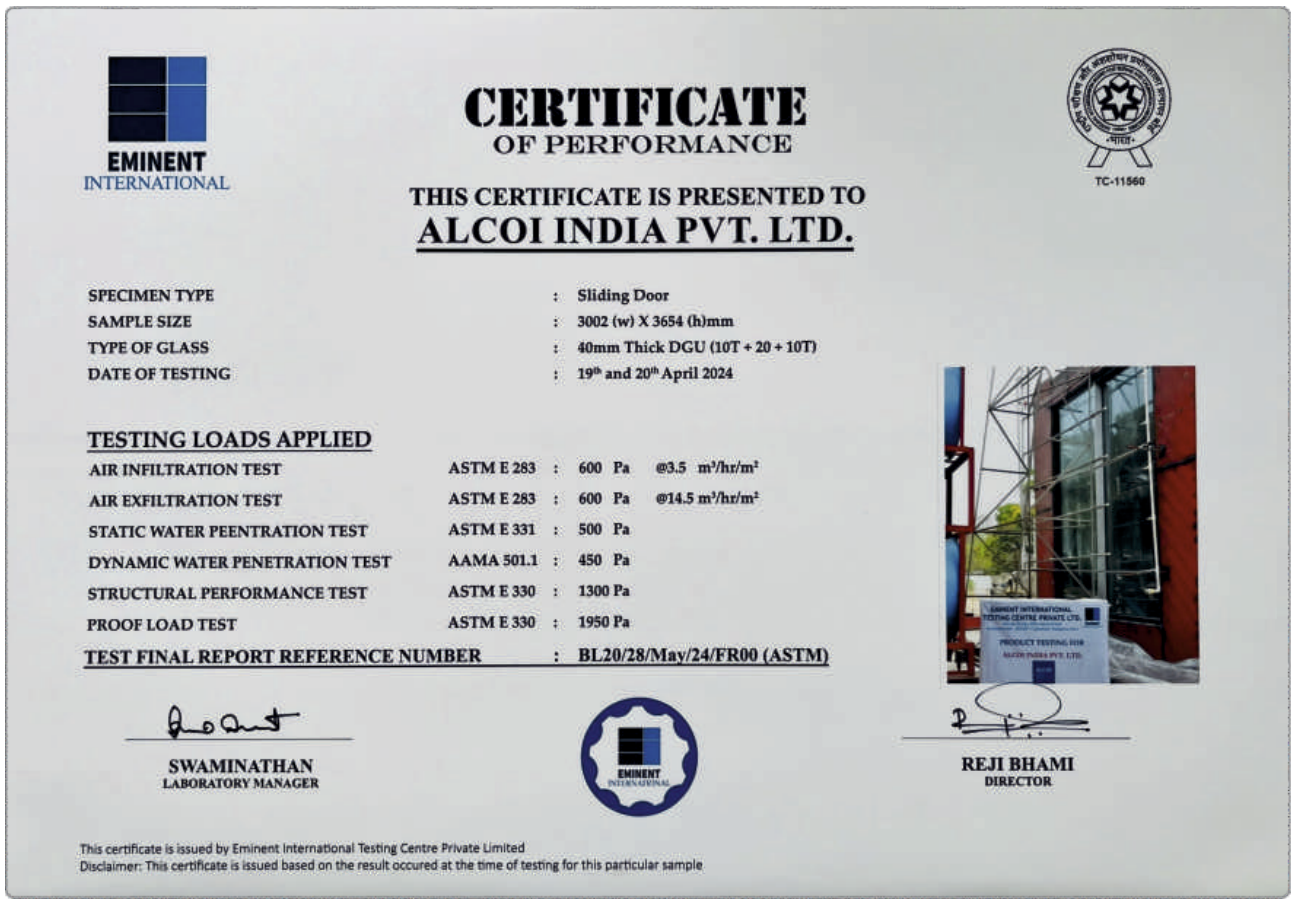
Certified Performance Transparency
Independent certificates from recognised testing centres document actual performance results. Architects and homeowners can request these documents to verify claims of resistance to water, air, and structural loads.
This transparency builds trust and aligns expectations with measurable outcomes rather than marketing statements.
Buyer Checklist Before Choosing Aluminium Doors and Windows
Before finalising your aluminium windows and doors, ask:
- Is this a tested aluminium window system or a locally fabricated product?
- Which air, water, and wind tests has it passed?
- Are certification reports available for verification?
- Is the hardware designed specifically for the system?
- Does the supplier understand installation and site conditions?
Clear answers usually indicate a reliable aluminium window manufacturer.
Conclusion
Testing and certification are what separate dependable aluminium fenestration systems from average ones. They ensure safety, comfort, and performance long after installation.
Choosing tested aluminium windows and doors is not about cost alone. It is about confidence, durability, and long-term value.
At ALCOI India, every system is built around verified performance, so what is installed today continues to work smoothly for years. Choosing tested fenestration is not about cost. It is about confidence.
FAQs
Why are testing and certifications important for aluminium windows and doors?
Testing confirms that aluminium windows and doors can withstand real-world conditions, including rain, wind, heat, and daily use. Without testing, there is no guarantee of long-term performance.
What is the difference between system aluminium windows and local aluminium windows?
System aluminium windows are engineered and tested as a complete unit. Local aluminium windows are fabricated using standard profiles without system-level testing, which often results in lower durability and performance.
Are aluminium sliding windows and aluminium sliding doors also tested as systems?
Yes. In a true aluminium window system, sliding windows and doors are tested with their frames, hardware, glass, and seals together to ensure smooth operation and resistance to wind and water.
Are international standards better than Indian standards for aluminium window systems?
Both are important. Indian standards address basic safety, while international standards test systems under more demanding conditions. Systems tested to international standards and adapted for Indian climates usually perform better over time.
How can buyers verify if an aluminium window system is genuinely certified?
Ask for official test reports, certification documents, and details of the testing laboratory. Reliable aluminium window brands in India provide transparent documentation.
Do tested aluminium fenestration systems cost more?
Tested aluminium window systems may cost more upfront, but they reduce long-term issues like leakage, repairs, and replacements, offering better overall value.